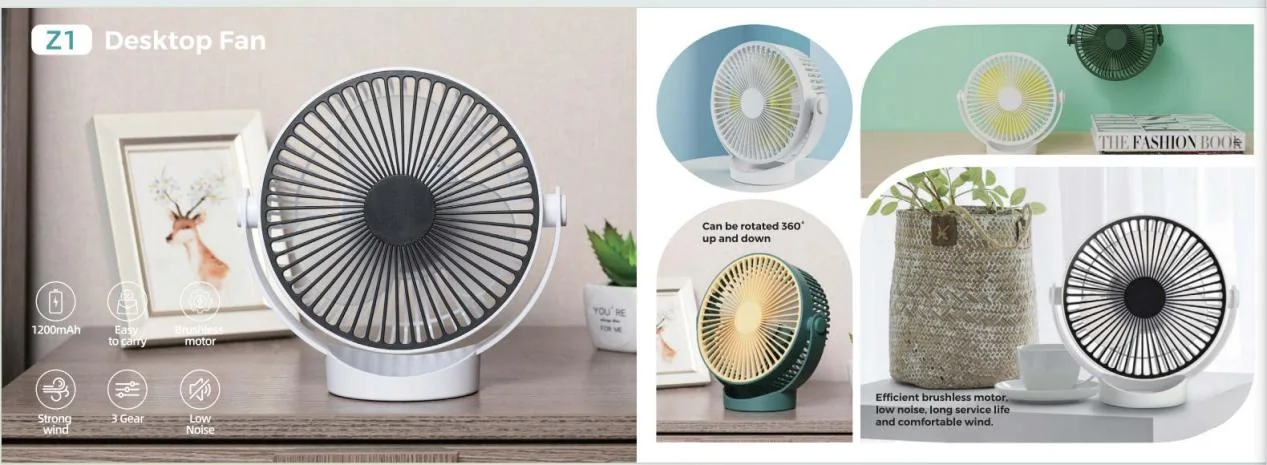
The best OEM portable fan is the model that fits a defined use case, price position and retail promise. Before requesting samples, buyers should compare placement, airflow controls, battery test conditions, mechanical stability, packaging and market requirements. A short decision brief makes supplier quotations easier to compare and reduces changes after artwork starts.
Huazeng’s portable fan range covers desk, handheld, neck-worn and clip-on formats. The checklist below is written for importers, distributors, promotional buyers and private-label teams building a practical shortlist.
1. Match the fan format to the customer use case
Start with where the fan will be used and how it will be supported. A desktop fan needs a stable base and useful adjustment. A clip-on fan needs secure grip on the intended surface. A handheld model needs manageable size and controls that can be operated with one hand. A neck fan adds questions about weight distribution and contact comfort.
| Format | Best-fit use | Sample priority |
|---|---|---|
| Desktop or table fan | Office, study, bedside | Stability, direction, low-speed sound |
| Clip-on fan | Shelf, stroller, compact workspace | Grip, vibration, aiming range |
| Handheld fan | Travel, outdoor queues, promotions | Weight, control access, carry method |
| Neck fan | Hands-free personal cooling | Balance, airflow direction, comfort |
Write one primary-use sentence before comparing specifications. “Rechargeable desk fan for quiet office use” is a more useful sourcing brief than “portable fan with strong wind.”
2. Compare airflow by test condition, not speed count alone
Three or six wind settings do not tell you whether the steps feel useful. During sample review, place competing fans at the same distance, use the same power state and compare every setting. Check whether the lowest setting is gentle enough for close desk use and whether higher settings introduce vibration or unstable movement.
The HZ-Z1 desktop fan, for example, lists three wind gears and 360-degree manual up-and-down adjustment. Those specifications should become specific sample checks: Is each speed distinct? Does the head stay in position? Does the base remain stable on a smooth desk?
3. Define battery and charging tests before asking about runtime
Runtime changes with wind setting, oscillation, lighting and battery condition. Ask suppliers for the stated test condition, then run your own repeatable scenario. Record the selected gear, any secondary functions, start and stop times, low-battery warning and charging indicator behavior.
Battery capacity is useful for model comparison, but it is not a runtime guarantee. The HZ-Z11 base and clip-on fan lists a 4000mAh battery, six wind gears, battery display and several rotation options. Buyers should test the configuration they intend to advertise rather than applying one runtime claim to every setting.
4. Check stability, adjustment and moving parts
Operate the tilt, oscillation and clip mechanisms repeatedly. Check whether joints loosen, cables interfere with movement, or vibration causes the fan to creep across a surface. For clip-on models, test the actual range of shelf, rail or stroller-bar thicknesses expected in the target use case.
If the model includes automatic oscillation, confirm the movement range and listen for mechanical noise at each speed. The HZ-Z8 table fan combines manual vertical adjustment, automatic horizontal movement and a night light, so cooling, movement and lighting should be checked separately and together.
5. Review safety, cleaning and everyday usability
Inspect grille openings, exposed edges, fasteners, cable entry, buttons and charging ports. Confirm that the grille and housing can be cleaned in the way the manual describes. Look for finger access risks, pinch points and parts that may detach during normal handling. Market-specific safety and documentation requirements should be confirmed for the final model and destination with the responsible compliance specialist.
6. Align the product, manual and packaging
Model number, input information, battery statement, accessories and control instructions should match across the product label, manual and color box. Avoid packaging claims such as “silent,” “all-day battery” or “safe for babies” unless the wording has appropriate evidence and approval for the target market.
Choose one primary retail promise and two supporting points. A desk fan might lead with controllable personal cooling, supported by adjustment and rechargeable placement. A clip-on model might lead with flexible mounting, supported by battery display and multiple speeds.
7. Use a structured portable fan RFQ
A useful request for quotation should include:
- target country and sales channel;
- preferred fan format and primary use;
- estimated order quantity and launch timing;
- required wind controls, adjustment and secondary functions;
- battery and charging expectations;
- logo, color, packaging and manual languages;
- documents or tests required for the destination market.
Send the same brief to every candidate supplier. Comparable inputs produce more comparable quotations and reveal which questions still need a sample.
Need a portable fan shortlist?
Send Huazeng your target market, fan format, estimated quantity and must-have functions. We can identify relevant models and prepare the next sample or quotation discussion.
Request a Portable Fan QuoteFrequently asked questions
What is the best portable fan format for an office?
A stable desk or table fan is usually the clearest fit. Compare footprint, adjustment, control access and sound at the lowest useful setting.
Should I choose a rechargeable or USB-powered fan?
Rechargeable models support flexible placement and travel. USB-powered products suit fixed desks with nearby power. Base the decision on the intended use and test the supplied charging configuration.
What should I test on a clip-on fan?
Test grip on each intended surface, stability at every speed, vibration during oscillation and whether the head remains easy to aim after attachment.
What details affect an OEM portable fan quotation?
Format, battery, motor and controls, secondary functions, color, logo, packaging, order quantity, destination and documentation requirements can all affect the final quotation.