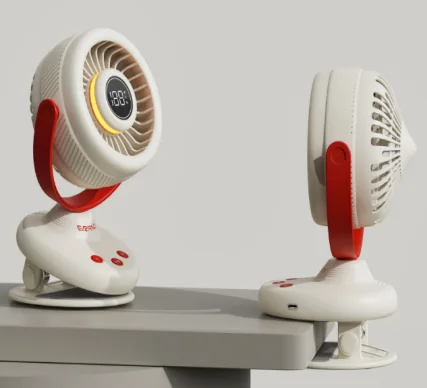
Portable fan buyers often compare battery capacity and speed settings before deciding how the product will actually be used. Format should come first. A desk fan, handheld fan and clip-on fan can use similar motors or batteries, yet each creates a different customer promise, packaging shape and sample test.
Huazeng's portable fan collection covers desktop, handheld, neck-worn and clip-on designs. Use this comparison to decide which formats belong in your shortlist before asking for samples.
Quick comparison by use case
| Format | Best starting use | Sample priority |
|---|---|---|
| Desk fan | Office, study, bedside or counter | Stability, direction, low-speed sound |
| Handheld fan | Travel, events and personal cooling | Weight, grip, controls and charging |
| Clip-on fan | Stroller, shelf, bed frame or compact workspace | Clip strength, surface fit and aiming |
Choose a desk fan for stable, repeat use
A desk fan suits buyers who want predictable placement and easy access to controls. Review the footprint, center of gravity, tilt range and oscillation before comparing maximum airflow. A product that moves across a smooth desk or drifts out of position will disappoint even if its top speed feels strong.
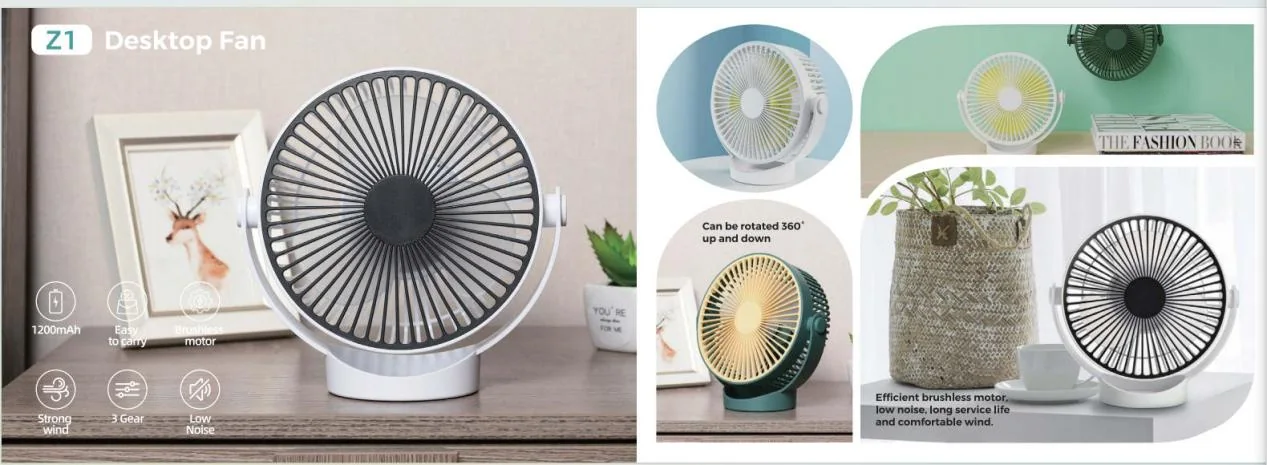
The HZ-Z1 desktop fan lists three wind gears and manual up-and-down adjustment. A useful sample check turns those specifications into actions: confirm that each speed is distinct, the head remains where it is set and the base stays stable during operation.
Choose a handheld fan for mobility
Handheld products compete on comfort as much as airflow. Record the weight and balance with the battery installed. Check whether the grip remains comfortable, whether the control can be pressed accidentally in a bag and whether the product can stand on a desk when that use is advertised.
Packaging should make the charging input, included cable and operating controls clear. If the design includes a lanyard or stand, test those accessories with the approved sample rather than treating them as decorative extras.
The HZ-F21 portable handheld fan can be reviewed against the exact channel requirement: travel retail may prioritize compact packing, while promotional programs may care more about logo visibility and color.
Choose a clip-on fan when placement flexibility matters
A clip-on fan needs to work on the surfaces named in the listing. Measure the usable clip opening and test representative shelf edges, desks, bed frames or stroller structures. Confirm that the pads grip without damaging the surface and that the fan remains aimed after the motor starts.
Multi-position models can simplify a range, but each mode needs approval. The HZ-Z11 base and clip-on fan lists six wind gears, a 4000mAh battery, battery display and several rotation options. Buyers should test desk and clip use separately, then record which configuration will appear in the packaging images.
Do not compare battery capacity alone
Capacity helps identify the installed battery, but runtime depends on speed, oscillation, lighting, battery condition and test method. Define one repeatable scenario for every shortlisted fan. Record the selected speed, active features, room conditions, start time, low-battery behavior and shutdown time.
Use that result to compare samples under the same conditions. Do not turn one test at the lowest speed into a broad runtime promise. The final listing should state only the claim supported by the approved configuration and method.
Compare control logic and noise in context
Count the steps required to reach the common setting. Check whether power and speed share one button, whether the unit remembers its last setting and whether indicators remain visible without being distracting. Controls that make sense in a factory sample should still make sense to a first-time customer.
Sound should be reviewed in the intended room. A gentle mechanical sound may be acceptable outdoors but distracting beside a bed or in a quiet office. Listen for tonal noise, rattles and changes when the fan tilts, oscillates or attaches to a hollow surface.
Match packaging to the format
Desk fans need protection around the base and adjustable head. Handheld fans need a compact pack that secures the controls and accessories. Clip-on models need packaging that protects the clip and shows correct attachment without implying unsafe uses.
Confirm dimensions, net weight, included cable, battery statement, speed count and accessories across the product specification, manual and box. Use images of the approved model and color.
Send a portable fan RFQ that supports comparison
- primary use and preferred fan format;
- target country, customer and sales channel;
- desk, handheld or clip surfaces to test;
- speed, oscillation, tilt and display requirements;
- battery and charging expectations;
- logo, color, packaging and manual languages;
- estimated quantity and launch timing;
- sample acceptance points.
Use the same brief for every model. Our OEM portable fan buyer checklist provides a second-stage review once the format and shortlist are clear.
Which fan format fits your retail program?
Tell Huazeng where the fan will be used, the target market, expected quantity and must-have controls. We can suggest relevant models for a focused sample comparison.
Compare Portable Fan ModelsFrequently asked questions
Is a clip-on fan better than a desk fan?
It is better when secure attachment and flexible placement are central to the use case. A desk fan is usually simpler for a stable workstation.
What should I test on a handheld fan?
Check grip, weight, controls, charging, accessories, airflow at each setting and behavior during transport.
Can battery capacity predict fan runtime?
Not by itself. Runtime also depends on speed, active functions and the test condition. Compare samples with one recorded method.
Can one fan serve as both a desk and clip-on model?
Some models support both placements. Test stability, adjustment and control access in each mode before using both claims in packaging.