A Bluetooth speaker quotation is only useful when suppliers are quoting the same product brief. If one supplier prices a compact 5W speaker while another prices an app-controlled display model, the numbers may look comparable but describe different commercial projects.
A stronger Bluetooth speaker OEM RFQ connects the customer, product platform, required functions, branding, packaging and target market. It gives a supplier enough information to identify a relevant model and tells your team which details still need sample approval.
1. Describe the customer and sales channel
Start with where the speaker will be sold and how customers will use it. A travel accessory, gift item, bedside speaker and party product may all be wireless speakers, but they need different sizes, controls, price positions and packaging.
Include the target country, primary customer, sales channel and intended retail position. “Portable speaker for online retail” is a starting point; “compact giftable speaker for desk and bedroom use, sold through European lifestyle stores” gives the supplier a more useful direction.
2. Choose the product platform before adding options
Tell suppliers whether you want a compact portable speaker, RGB party speaker, soundbar, display speaker or wireless-charging design. Platform choice affects the product size, battery, enclosure, user interface, packaging and available customization.
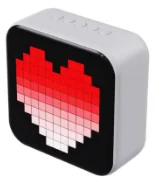
For an interactive concept, the HZ-B313 pixel-art Bluetooth speaker combines a 5W speaker, app control, TWS, RGB lighting and a time display. Those functions create a different approval plan from a straightforward portable speaker. State which functions are essential and which are optional before requesting a price.
3. Define the audio and connection requirements
List the output configuration, Bluetooth version preference, playback modes and any connection features that matter to the channel. Depending on the model, your brief may include stereo output, TWS, USB, TF card, AUX, hands-free calling or app control.
Avoid using a broad phrase such as “strong bass” as the only audio requirement. Instead, describe the use case, preferred size, listening environment and the sample checks you will perform. Ask the supplier to separate confirmed specifications from performance claims that require testing.
4. Record battery and charging expectations
Include the battery capacity you are considering, charging input, preferred connector, charging time target and the playback scenario used for any runtime claim. Runtime depends on volume, lighting, connection mode and battery condition, so one number without a test method can create confusion.
If wireless charging is part of the concept, treat it as a separate requirement. The HZ-B275 wireless-charging speaker combines dual 5W speakers, an 1800mAh battery and a listed 15W maximum wireless-charging function. Your RFQ should state which phone conditions, input source and simultaneous-use tests matter.
5. Separate must-have features from retail options
Put the feature list into three groups: required for the first sample, preferred if available, and optional for a later version. This helps prevent a quote from becoming a list of unpriced assumptions.
- Core audio: output, speaker count, sound profile and connection mode;
- Interface: buttons, display, app, lighting and voice prompts;
- Power: battery, charging input, runtime test and indicator behavior;
- Secondary functions: TWS, USB, TF, AUX, wireless charging or microphone;
- Physical details: size, handle, material, color and control layout.
For a model such as the HZ-B150 RGB speaker, ask the supplier to confirm which lighting modes, battery figures and control functions belong to the quoted configuration rather than assuming every photographed feature is included.
6. Give suppliers a usable branding brief
Send the logo file, intended decoration position, color direction, finish and any minimum clear-space rules. A logo on a flat housing may use a different process from a logo on fabric, a grille or a curved surface. Request a decoration proof before approving the sample.
Also state whether you need a stock color, a custom color or several colorways. If color is important to the retail program, identify the reference standard and the physical sample that will be used for approval.
7. Define the packaging and documentation scope
List the packaging format, language, barcode, manual, accessories, carton marks and destination labels. Tell the supplier whether you will provide artwork or need support with a dieline and packaging layout.
Before final artwork, reconcile the model number, Bluetooth version, battery statement, output, charging input, accessories and supported playback modes across the product, manual, carton and online listing. Unsupported claims are expensive to correct after printing.
8. State quantity, timing and destination
Include estimated order quantity, expected color split, sample deadline, launch timing, destination country and shipping terms under discussion. If the first order is a market test, say so. A supplier can then explain which customizations are practical at the initial quantity and which may require a later scale-up.
Ask for sample cost, sample lead time, production lead time, packaging assumptions and the validity period of the quotation. Keep these commercial points separate from specifications so changes are easy to track.
9. Ask for a model-specific answer
A useful reply should identify the proposed model or models, confirmed specifications, available options, open questions, sample plan and quotation basis. If the answer only says “customization available,” ask for the exact surface, function, packaging and quantity assumptions behind that statement.
Use the same RFQ brief with every supplier. Then compare like with like: model, functions, decoration, packaging, quantity, destination and timing. A lower price is not necessarily better if it excludes the features your customer expects.
Need a comparable Bluetooth speaker quotation?
Send Huazeng your target market, preferred speaker format, required functions, branding direction, estimated quantity and launch timing. We can help identify suitable models and define the next sample step.
Request a Speaker QuoteFrequently asked questions
What is the most important information in a Bluetooth speaker RFQ?
Start with the target market, use case, product format, must-have functions, quantity, branding, packaging and timing. These details give the quotation a clear commercial context.
Should I request a quote before choosing a model?
Yes, but ask suppliers to identify the model and configuration behind each price. Otherwise, quotes may describe different speaker platforms.
How should I compare speaker runtime claims?
Compare the test condition, volume, lighting state, connection mode, battery and shutdown behavior. A runtime number without conditions is not a reliable like-for-like comparison.
Can a stock Bluetooth speaker become a private-label product?
Many projects begin with an existing product platform. The available logo, color, packaging and function options depend on the selected model, quantity and required sample approval.